
|
Front page Sharks Shark records FAQ Banners Site news Did you know? Links and books Shark quiz Contact |
|
Sprog / Language:  |
Baskingshark
|
|
|
 |

|
The Basking Shark is called Cetorhinus Maximus in Latin, it is the world's second
largest fish. The Basking shark can be more than 40 ft. long, but normally they do not
get bigger than 25 ft. long to 30 ft. long. The Basking Shark is one of the 3 species
of sharks that feed on plankton, the others are the Whale Shark and Mega Mouth.
The shark is not dangerous to humans. Basking Sharks are often found in groups,
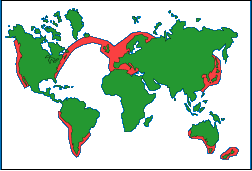
these groups can contain more than 100 individuals. The Basking Shark is a big greyish shark with a sharp snout. The Basking Shark has very long gill slits that nearly go the whole way around its head. Basking Sharks have some special gill rakers that keeps plankton, when the shark filters the water. The Basking Shark can filter about 500.000 gal an hour and by doing that it a huge amount of plankton. There is not much information about the reproduction of Basking Sharks, but they become sexually mature when they are about 20 ft. long. After the Basking Shark has been pregnant in about 3½ years it gives birth to live young, but there is no knowledge about how many they give birth to at a time. The Basking Shark lives in temperate waters with a temperature from 16 to 17 oC (60-62 F), the Norwegian Sea, the Mediterranean Sea, the Pacific Ocean, The North Sea and the Atlantic Ocean. The Basking Shark migrates with the seasons and can be found near the coast of Britain from the beginning of June to the middle of September. At daytime the Basking Shark moves in the surface much of the time. At Isle of Man you can be lucky to see big schools of Basking Sharks even close to the shore. The rest of the year it is not known where they migrate to. The Basking Shark cannot be kept in captivity like many other species of sharks, because it demands too much space and too much food. Scientists believe that around 5000 Basking Sharks is captured every year, this means that it gradually disappears from many areas, where it once was common. The Basking Shark is captured because they have an oleaginous liver which can contain up to 230 gal. of oil.
|